
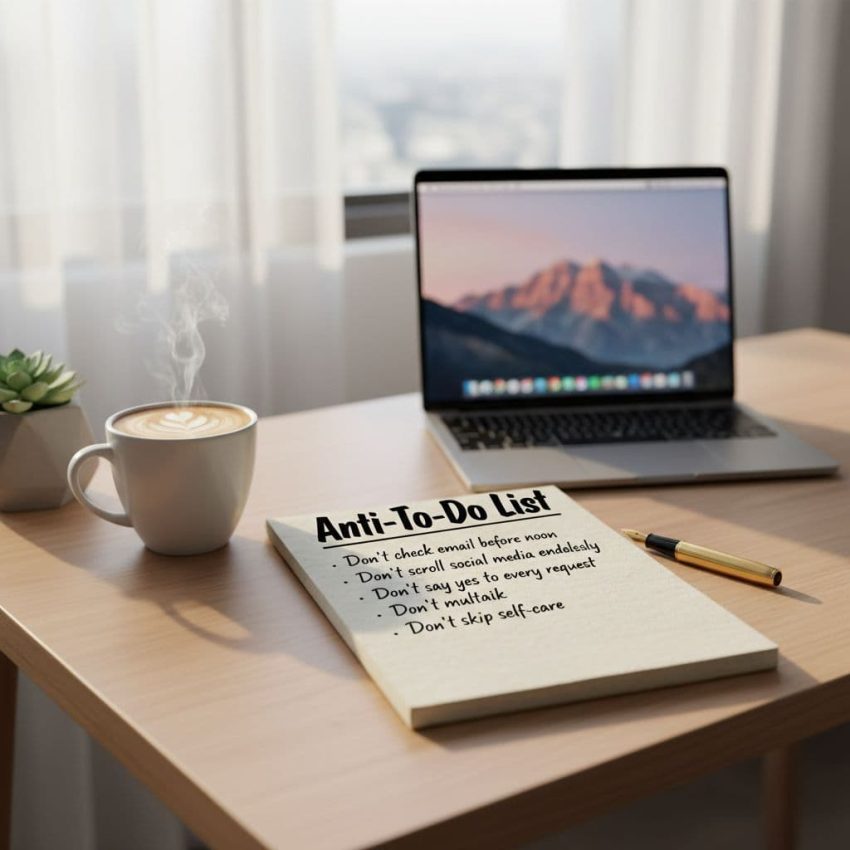
The Anti-To-Do List: Track What You Finished to Spot What Actually Works
You start the day with a clean plan. A neat to-do list. Maybe even time blocks. Then real life shows up, a surprise meeting, a client email, a kid gets sick, a login breaks, and suddenly it’s 6:30 p.m.
You look at the list and feel behind, even though you’ve been moving all day.
That’s where the Anti-To-Do List helps. It flips the script. Instead of writing what you hope to do, you write what you actually finished. That small shift gives you proof of progress, a clearer view of how your time really gets used, and a way to spot what’s working so you can repeat it. It’s not about doing more. It’s about learning what moves the needle.
What an Anti-To-Do List is (and why it works when normal lists fail)
An Anti-To-Do List is a simple record of what you completed today.
A normal to-do list is a set of promises. You write it in the calm before the storm, then spend the day defending it. When you don’t hit everything, the list doesn’t just sit there, it judges you.
Planned lists fail for boring, human reasons:
- You guess wrong about time, because tasks hide extra steps.
- Interruptions wreck your schedule, even on “quiet” days.
- A lot of work is invisible, like thinking, deciding, and fixing.
- You forget what you did, so your brain labels the day “unproductive.”
The Anti-To-Do List works because it matches reality. It gives you visible wins, which reduces guilt and helps your brain connect effort to results. It also creates a feedback loop. When you can see what you actually finish, you can plan with real data next time, not wishful thinking.
This isn’t just for office work. It fits school (assignments completed), parenting (appointments handled, meals made), and personal goals (workouts done, calls made, bills paid). Anywhere you want progress without the constant feeling of falling behind, it helps.
A short example day might look like this:
You planned: “Write proposal, clean inbox, schedule dentist, start workout plan.”
Your day actually included: fixing a payment issue, two urgent calls, sending the proposal, and booking the dentist. A normal list says you failed. An Anti-To-Do List shows you handled real priorities and still shipped important work.
The key difference: proof of output, not promises
Think of it like a workout log. You don’t write “bench press 200” and feel strong. You write what you lifted, and that’s what counts. The Anti-To-Do List is the same, it’s proof.
Here’s a quick mini-example.
Promise list:
- Draft newsletter
- Outline new offer
- Reply to all emails
- 60-minute workout
Done list:
- Drafted and scheduled newsletter
- Replied to 12 customer emails that blocked orders
- Fixed checkout link on sales page
- Took a 20-minute walk after a stressful call
What do you learn from the done list? Your real capacity today was about shipping one key asset (the newsletter) plus handling revenue-blocking problems. You also learn that “reply to all emails” is not a task, it’s a bucket. And you learn what breaks your plan, like support issues, so you can plan for them.
Over time, this becomes a map of where your hours go, and what you can actually finish in a day.
What counts as “done” (including the invisible work)
“Done” means the task is finished enough that it created a result, removed a blocker, or moved something forward.
That includes obvious wins, like sending a proposal or submitting an assignment. It also includes the work people skip because it’s hard to measure:
- Decisions made (picked a vendor, chose a topic, said no)
- Meetings that mattered (aligned on next steps, solved a problem)
- Important conversations (feedback, conflict, coaching, support)
- Admin chores (forms, scheduling, budgeting, resets, returns)
- Recovery tasks that support performance (workout, nap, early bedtime)
One caution: don’t over-log tiny actions just to look busy. If you write “opened laptop” you’ll get clutter, not clarity. Aim for items that would make you say, “Yes, that mattered.”
How to start an Anti-To-Do List in 5 minutes a day
You can start today with a sticky note, a notebook, or a note on your phone. The best tool is the one you’ll actually use when you’re tired.
Keep it friction-free. No fancy system. No long setup. The goal is to capture finished work so you can see patterns later.
Here’s a simple way to do it:
- Create one note called “Anti-To-Do List”.
- Add today’s date at the top.
- Throughout the day, add a bullet when you finish something.
- If you forget, do a 2-minute sweep at the end of the day.
- Stop at 3 to 10 bullets. If you did more, group similar tasks.
Messy days are where this shines. When you get pulled in ten directions, a normal plan falls apart. A finished list still tells the truth. It also gives you a small sense of control, because you can point to what you handled.
If interruptions are constant, try one rule: when you close a loop (send it, submit it, schedule it, decide it), write it down right away. That takes five seconds and stops the day from turning into a blur.
A simple daily template you can copy
Date:
Finished:
Moved forward:
Notes:
Optional tags you can add at the end of a line: (deep work), (admin), (people), (urgent), (energy)
Keep the template short. You want it to fit in a small note and feel easy to maintain.
Use light categories to spot patterns without extra work
Categories help you see what your week is made of, without turning your list into a project.
Use 2 to 4 simple buckets you can remember. For many people, these work well:
- Results (work that creates output, sales, grades, finished deliverables)
- Relationships (clients, coworkers, family, community)
- Maintenance (admin, cleanup, errands, upkeep)
- Learning (practice, reading, training, skill-building)
You can tag items quickly and move on. Example:
- Sent proposal to ACME (Results)
- Helped kid with math review (Relationships)
- Paid bills and filed receipts (Maintenance)
- Watched 30 minutes of Excel tutorial (Learning)
After a few days, you’ll notice patterns without trying. If “Maintenance” is eating half your list, you’ve found a reason you feel behind. If “Results” is rare, you’ll know why goals are stalling. This is where the Anti-To-Do List stops being a feel-good habit and becomes useful data.
Turn your finished list into a “what works” system you can trust
The magic isn’t only in writing things down. It’s in reviewing the list and changing what you do next.
Once a week, take 10 to 15 minutes. Look at your daily Anti-To-Do entries and ask, “What got results, and what just took time?” This turns your finished list into a planning tool that’s based on your real week, not your imaginary one.
Use what you see to make three moves:
- Do more of what worked (repeat the tasks that create results).
- Cut what didn’t (reduce tasks that drag on with little payoff).
- Plan with accuracy (schedule fewer big tasks, leave space for interrupts).
This also protects your time. When someone asks you to add one more thing, you can check your list and say, “If I add that, what drops?” That’s a calmer way to set limits, because you’re using evidence, not emotion.
The 3-question weekly review that reveals what to repeat
Use these three questions:
- What created the best result this week?
- What drained time with little payoff?
- What kept showing up that should be automated, delegated, or deleted?
Circle your top 3 wins. Then write one sentence on why each mattered. Maybe it brought in revenue, prevented a problem, improved a relationship, or cleared mental space. That one sentence helps you recognize high-value work when it appears again.
End your review with a simple plan for next week:
- Keep: one or two actions to repeat
- Stop: one thing to reduce or remove
- Start: one small change to test
Common mistakes that make the Anti-To-Do List less useful
The Anti-To-Do List should feel supportive, not harsh. A few mistakes can ruin it.
Some people use it to judge themselves. Fix: write it like you’re coaching a friend, keep it kind and factual.
Some people log everything to look busy. Fix: keep it short, focus on finished loops and real progress.
Some people ignore outcomes. Fix: add a tiny note when something mattered (“closed sale,” “unblocked project,” “calmed a conflict”).
Some people never review it. Fix: set a weekly reminder, keep it to 15 minutes, and stop when you’ve chosen one “keep,” one “stop,” and one “start.”
Conclusion
Your finished work is the best data you have. A to-do list shows what you hoped would happen, but an Anti-To-Do List shows what actually did happen, and that’s where the truth lives.
Try it for seven days. Keep it simple, write down what you completed, then do one short weekly review. You’ll start to see what creates real results, what steals time, and what you can plan better next week.
Start today by writing three things you already finished, and keep the list where you’ll see it. Small proof adds up, and progress gets easier to trust.